Swiss glaciers lose more than 5% of ice after record heatwave
Switzerland's glaciers lost 5.5% of their ice in 2026, their second-biggest annual decline on record, researchers reported.

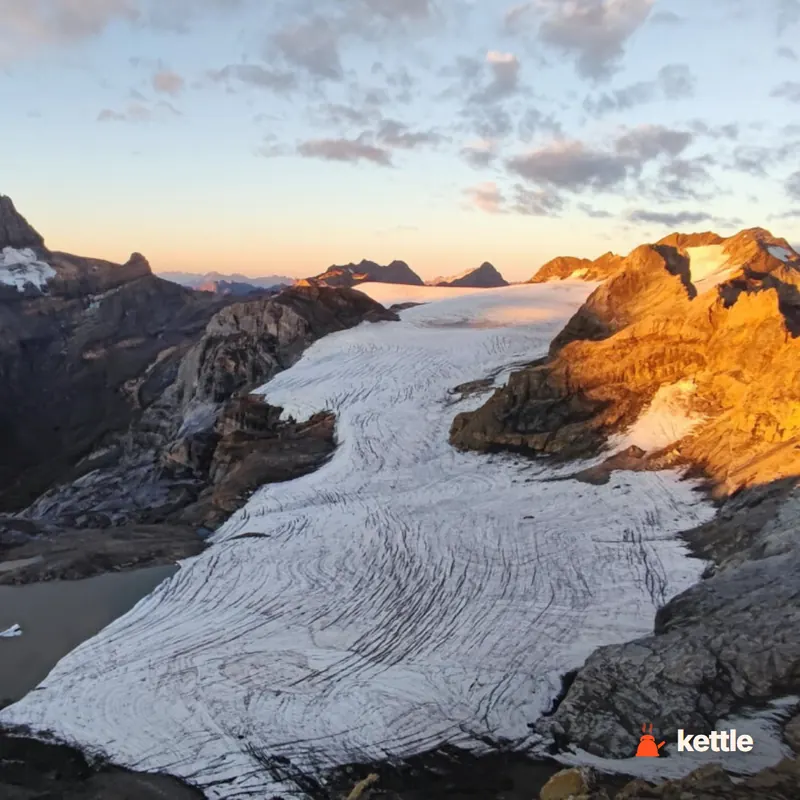

Switzerland's glaciers lost more than 5% of their ice in 2026, according to a report from the country's glacier monitoring network, Reuters reported. The Associated Press, in a report carried by ABC News, put the exact figure at 5.5%, calling it the second-biggest annual loss on record after heat waves and lighter snowfall accelerated the melt.
The decline matters because Switzerland's glaciers feed major European rivers that supply water for farming, shipping and power generation, according to NPR. Matthias Huss, who leads the glacier monitoring network GLAMOS and helped produce the report with the Swiss Academy of Sciences, said the loss threatens water supplies and infrastructure far beyond the mountains, NPR reported.
GLAMOS's report found that 2026's loss was only slightly below the record 6% drop recorded in 2022, and that the gap was due mainly to slightly heavier winter snow cover this year, according to NPR. Some individual glaciers, including the Rhône and the Aletsch, Switzerland's largest, suffered record ice loss this year despite the overall figure trailing 2022, NPR reported.
Huss told NPR he returned this summer to glaciers he had studied for years and found much of the ice gone. "They are completely devoid of ice," he said, describing what remained as "a moon landscape that is dry and dead," with only scattered ice blocks melting on hot rocks, according to NPR.
NPR reported that Europe's rivers, including the Rhine and the Danube, depend on glacier meltwater, and that this summer's low river levels halted freight transport on both waterways and forced the temporary shutdown of river-cooled nuclear power stations. Huss told NPR, "It's the food supply, it's the transportation chains," warning that once the glaciers vanish, drought could threaten Europe's farmers; NPR noted 1,200 smaller glaciers have already disappeared over the past 50 years.
NPR also reported that glaciers and alpine permafrost help stabilize mountain terrain, and that their loss raises the risk of landslides and flooding. Last year a glacial collapse triggered a landslide that destroyed 300 homes in the Swiss village of Blatten, and although residents had been evacuated in advance, a year later they remain in temporary housing with no certainty about returning to homes now buried beneath an estimated 9 million cubic meters of mud, rock and ice, according to NPR. NPR also reported that a glacier collapse on Nepal's border with Tibet this summer triggered floods that killed at least 1,400 people, though Huss cautioned against drawing a direct, simple link between warming and such disasters, saying climate change "can be a triggering factor" when combined with heat and permafrost thaw.
Huss told NPR that the glacier losses should put to rest doubts about climate change, saying, "Look at them, it's not a hoax. The evidence is clear, and it's been clear for decades." NPR reported that the glacier monitoring unit predicts all of Switzerland's glaciers will disappear by the end of this century if current warming trends continue.
Why it matters
Switzerland's shrinking glaciers feed major European rivers that supply water for agriculture, shipping and power generation, and their continued loss raises risks of drought, landslides and flooding across the region, according to NPR.
Key facts
- Swiss glaciers lost 5.5% of their ice in 2026, the second-biggest annual loss on record, according to the AP/ABC News.
- The record annual loss was 6%, set in 2022, according to GLAMOS data reported by NPR.
- This summer's low river levels halted freight transport on the Rhine and Danube and forced temporary shutdowns of river-cooled nuclear plants, NPR reported.
- A glacier collapse on Nepal's border with Tibet this summer triggered floods that killed at least 1,400 people, according to NPR.



Comments
Loading comments…